Understanding Prop Trading: Unlocking Financial Opportunities

What is Prop Trading?
Proprietary trading—often referred to as prop trading—is a financial practice where firms invest their own capital in the markets, rather than trading on behalf of clients. This approach has gained traction, particularly because of its potential for significant profits. So, what exactly does prop trading entail, and how does it operate in the realm of cryptocurrencies? In this article, we’ll address these questions and dive into the nuances of proprietary trading.
Understanding Proprietary Trading
At its essence, proprietary trading means that firms are trading assets like stocks, bonds, commodities, or derivatives using their own funds. The main objective is to generate profits from the market through speculative trading.
The Mechanics of Prop Trading
Prop trading firms typically employ a broad range of strategies. They often utilize advanced algorithms, high-frequency trading, and thorough market analysis—all aimed at capitalizing on minor price fluctuations to turn a profit. Unlike traditional brokerage firms, which manage client funds, prop trading entities operate with much more flexibility and the potential for greater returns.
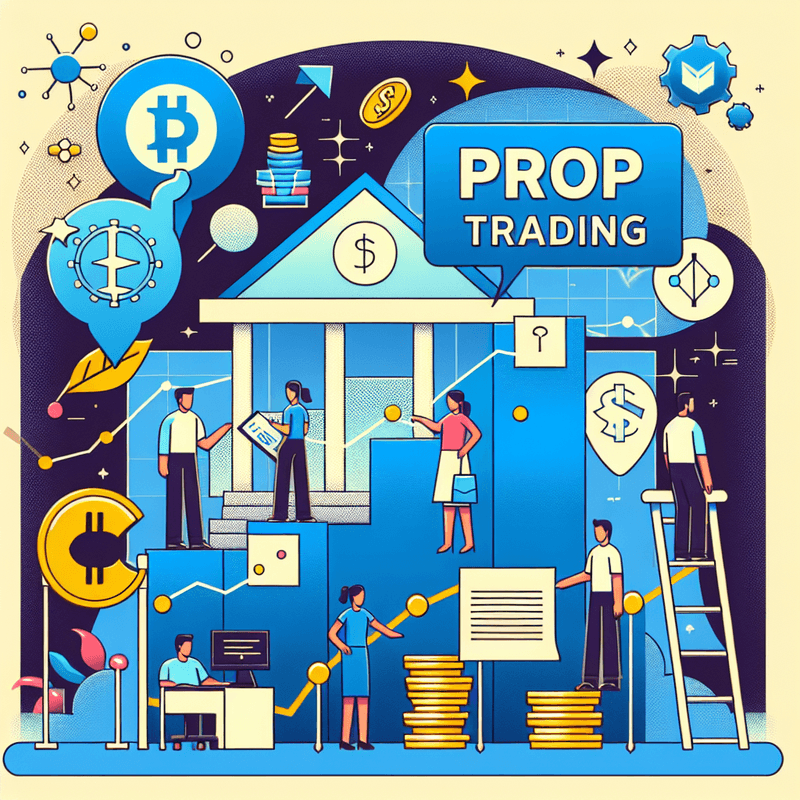
Key Strategies in Proprietary Trading
- Arbitrage: Taking advantage of price differences across various markets or instruments.
- Market Making: Offering liquidity by providing both buy and sell prices.
- Trend Following: Spotting and capitalizing on long-term market trends.
- Mean Reversion: Assuming that prices will eventually return to an average level.
Benefits of Prop Trading
- Independence: Firms have total control over their trading strategies and decisions.
- Leverage: Access to substantial capital allows firms to leverage positions, magnifying potential returns.
- Advanced Technology: Using cutting-edge technology and algorithms significantly enhances trading efficiency.
Prop Trading in the Crypto Market
The cryptocurrency market—known for its volatility and liquidity—offers unique opportunities that are especially appealing to prop trading firms. Cryptocurrencies like Bitcoin and Ethereum, along with countless altcoins, have become prime assets for proprietary traders.
Crypto Futures and Perpetual Contracts
In the crypto world, futures and perpetual contracts provide prop traders the chance to speculate on price changes without ever taking physical ownership of the assets. These financial instruments enable traders to leverage their positions and profit from market fluctuations.
How Prop Traders Use Futures and Perpetuals
- Hedging: Reducing risk by taking opposite positions in the spot market.
- Speculation: Capturing price movements without needing direct ownership of the assets.
- Leveraging Positions: Boosting returns by borrowing capital to increase market exposure.
Tools and Technology in Prop Trading
The success enjoyed by prop trading hinges heavily on the tools and technologies that traders utilize. In our digital age, artificial intelligence and automation play a crucial role.
The Role of AI and Automated Systems
Sophisticated AI systems analyze vast amounts of data to guide traders in their decision-making. Platforms like CrewDegen showcase the forefront of automated trading technology. These systems autonomously collect news and technical data, harness multiple AI agents for analysis, and execute trades seamlessly across both centralized and decentralized exchanges. This level of automation provides traders with the ability to make swift, informed decisions—capabilities that human traders often struggle to match.

Benefits of Utilizing AI in Prop Trading
- Speed: AI can process data and execute trades in mere milliseconds.
- Accuracy: Reduces the likelihood of human error during trade execution and decision-making.
- Sentiment Analysis: Assesses market sentiment to project potential price movements.
Challenges in Proprietary Trading
Even with the chance for substantial gains, prop trading comes with its own set of challenges.
The Risks Involved
- Market Volatility: While volatility can be advantageous, it also heightens the risk of significant losses.
- Regulatory Risks: Keeping up with financial regulations can be complicated and overwhelming.
- Technological Failures: Dependence on technology means that system breakdowns can lead to devastating consequences.
Comparison of Prop Trading vs. Traditional Trading
Proprietary trading is quite different from traditional trading models. Here’s a breakdown:
| Aspect | Prop Trading | Traditional Trading | Key Difference |
|---|---|---|---|
| Capital Source | Firm's own capital | Client's capital | Ownership of funds |
| Objective | Maximize firm's profit | Client satisfaction | Primary goal |
| Risk | High | Typically lower | Risk exposure |
| Decision Making | Firm-controlled | Client-influenced | Control over trading decisions |
| Technology Use | Advanced AI, algorithms | Varied | Level of technological adoption |
Conclusion
Proprietary trading represents a dynamic and high-stakes arena that has evolved profoundly alongside technological advancements and the rise of cryptocurrency markets. By leveraging sophisticated strategies and cutting-edge tools—such as those provided by CrewDegen—prop traders can adeptly navigate complex financial landscapes with a level of agility and precision that's hard to match.
Whether you're just starting out as a trader or you’ve been in the game for a while, understanding the intricacies of prop trading is crucial for tapping into its potential while also mitigating its inherent risks. With the right approach, prop trading can indeed be a rewarding venture in the fast-changing world of finance.